
 Skip to content
Water And Ice Safety: read this before you go
Part of Things To Do, our guides to parks, lakes, trails, camping, museums and clubs in the White Mountains.
Arizona’s state flower is the saguaro blossom and its state tree is the palo verde, but around Show Low the plants to know are quaking aspen, ponderosa pine, junipers, pinyon and Gambel oak. Aspens and the Forest Service’s fall color tips are covered below; the Arizona Native Plant Law and Forest Service rules say what you may not pick, dig or cut.Checked October 30, 2026.
Checked · Edited by the It's Show Low Editorial Team · Sources · How we check
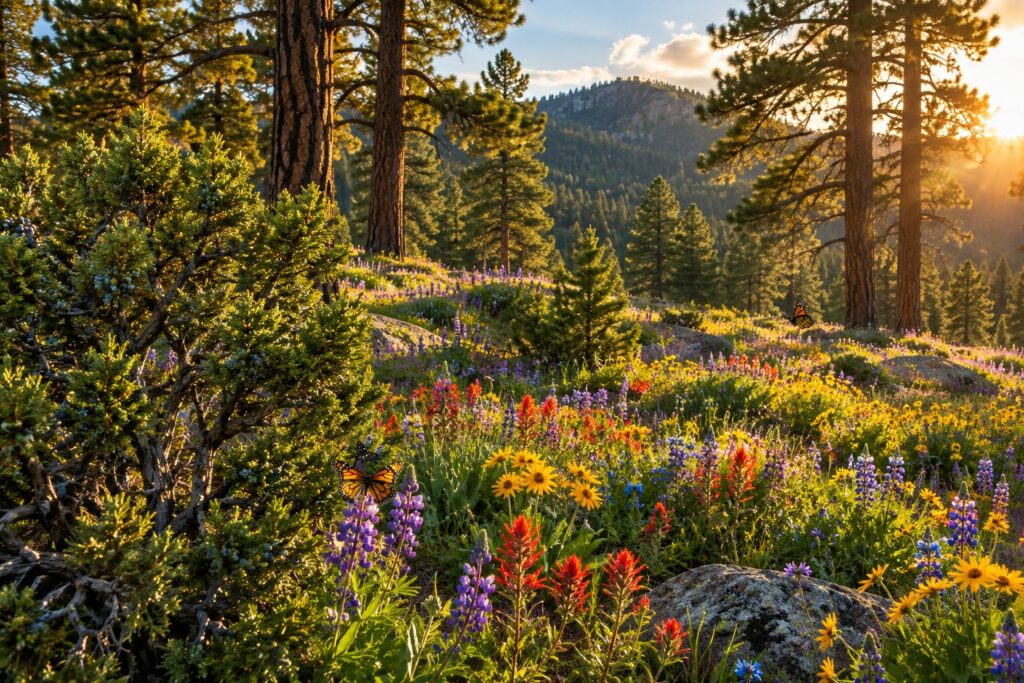
Wildflowers, Trees and Plants You Might See
Where and when come from the source on each card. Bloom and color times are “typically”: they shift with rain and temperature every year, so check with the forest, park or garden before you go. Information as of October 30, 2026.
State Symbols
Saguaro Blossom (State Flower)
Where and When, Per the SourceArizona law names “the pure white waxy flower of the cereus giganteus (giant cactus) or Saguaro” as the state flower. We read no source on whether saguaros grow near Show Low, so this guide does not place one here.
Care NoteCacti are a protected plant group under the Arizona native plant rules; see Staying Safe and Leaving Plants Be.
SourceA.R.S. 41-855; Arizona Administrative Code, Title 3, Ch. 3
Palo Verde (State Tree)
Where and When, Per the SourceArizona law names the palo verde, genera cercidium, as the state tree. The rules list blue palo verde and foothill palo verde as salvage assessed plants, which need a permit to remove. We read no source placing palo verde near Show Low.
SourceA.R.S. 41-856; Arizona Administrative Code, Title 3, Ch. 3
Petrified Wood (State Fossil)
Where and When, Per the SourceArizona law names petrified wood, araucarioxylon arizonicum, the official state fossil. It is stone, not a living plant, so the native plant law does not cover it; we did not read the rules for collecting it.
SourceA.R.S. 41-853
Aspens and Fall Color
Quaking Aspen
Where and When, Per the SourceThe Forest Service says that in Arizona and New Mexico quaking aspen is most abundant between 6,500 and 10,000 feet, is common in mixed conifer forests, and in the Southwest is most common on north-facing slopes. A grove is often a clone: the trees are joined by one root system. Its national fall-color page calls out “golden aspens, cottonwoods, and willows” in the Apache-Sitgreaves, especially around Big Lake and Hannagan Meadow, and gives no dates.
Care NoteStay on roads and trails, and do not cut or carve trees: the Forest Service bars cutting or removing trees and forest products without authorization (see Staying Safe).
Cottonwood and Willow
Where and When, Per the SourceThe Forest Service describes cottonwood as soft yellow along rivers and floodplains and willows as gold in moist areas and canyons. Its page does not say which White Mountains streams hold them, except the Big Lake and Hannagan Meadow mention above.
Maples and Oakbrush
Where and When, Per the SourceThe same page says bigtooth and Rocky Mountain maple turn red and orange in canyons, and oakbrush and Gambel oak turn rusty reds and browns. It does not say where in the White Mountains maples grow.
Ponderosa Pine, Juniper, Pinyon and Oak Woodland
Ponderosa Pine
Where and When, Per the SourceArizona State Parks describes Fool Hollow Lake as a place to camp among tall ponderosa pines at 6,300 feet. For the pine, juniper and high-desert plants of the Mogollon Rim, see our Mogollon Rim plants guide.
Alligator and Oneseed Juniper
Where and When, Per the SourceThe Forest Service says alligator juniper occurs in the pine-oak woodlands of Arizona, at somewhat higher elevations than oneseed or Utah juniper, and notes its shreddy bark was used to make torches. Oneseed juniper is reported in Arizona at 3,000 to 7,000 feet; Show Low sits near 6,400, inside that range, though we read no page that places either juniper locally.
SourceForest Service: alligator juniper; Forest Service: oneseed juniper
Twoneedle Pinyon
Where and When, Per the SourceThe Forest Service says birds cache its seeds: Clark’s nutcrackers, scrub jays, pinyon jays and Steller’s jays. The page gives no local range for the White Mountains.
Gambel Oak
Where and When, Per the SourceIn Arizona, Gambel oak mostly grows as shrub thickets, and at 8,000 to 8,600 feet it grows with ponderosa pine and southwestern white pine, per the Forest Service. Its leaves turn rusty red and brown in fall (Forest Service fall-colors page).
SourceForest Service: Gambel oak; Forest Service: fall colors
Wildflowers and Bloom Timing
When Wildflowers Open at High Elevations
Where and When, Per the SourceArizona State Parks says parks at higher elevations see flowers later in the spring, around May, and the blooms last well into the summer. It adds that the season depends on rainfall and temperature, and that there is typically more rain up north. The page does not name White Mountains species or dates.
Care NoteCall the park or forest office before you drive out for flowers.
Monsoon Bloom
Where and When, Per the SourceWe found no official page that says when or where the monsoon brings wildflowers to the White Mountains, so this guide does not make that claim. The State Parks page says only that bloom depends on rainfall.
Care NoteMonsoon storms bring lightning and flash flooding; check the National Weather Service forecast before you hike (general guidance).
New Mexico Thistle
Where and When, Per the SourceArizona State Parks says this forb can top six feet and blooms March through September after above-average rainfall. The page does not say it grows near Show Low.
Columbines, Shooting-Stars, Mariposa-Lilies, Lemon Lilies and Wild Orchids
Where and When, Per the SourceThese are named in the Arizona native plant rules as protected plants (columbine, shooting-star, mariposa-lily and lemon lily by genus; all orchids; all lilies not otherwise listed). We do not say where any of them grow.
Care NoteLook and photograph; do not pick or dig. Taking them without a permit is a crime on state and private land.
Plants to Leave Alone
Poison Ivy
Where and When, Per the SourceMedlinePlus says the sap is in the root, stems, leaves and fruit and causes a blistering rash. We read no official page confirming where poison ivy grows near Show Low, so learn its look before you hike and stay out of any unfamiliar vine or shrub.
What To DoNever burn it: MedlinePlus says smoke from burning carries the sap into eyes, nose, throat and lungs. After contact wash skin and clothing right away; see a doctor for a severe rash.
SourceMedlinePlus
Sacred Datura
Where and When, Per the SourceArizona State Parks calls it a weedy plant with showy white flowers in disturbed areas and says all parts of the plant are poisonous. We did not read where it grows near Show Low.
What To DoDo not touch or taste. Keep children and dogs away.
Fiddleneck
Where and When, Per the SourceArizona State Parks says this yellow-orange upland desert flower irritates human skin on contact. We did not read whether it grows near Show Low.
What To DoDo not handle it.
Public Gardens
Boyce Thompson Arboretum, Superior
What the Site SaysIts site lists Arboretum Way in Superior, Arizona, and describes a new Wallace Desert Garden of 13 acres with 1.5 miles of trails. It is a desert garden in another part of the state, not a White Mountains one; we looked up no drive time.
Visiting NoteCheck hours and admission on the arboretum’s site; we took neither.
SourceBoyce Thompson Arboretum
Desert Botanical Garden, Phoenix
What the Site SaysIts site lists Galvin Parkway in Phoenix. Like the arboretum, it shows desert plants, not mountain ones; we looked up no drive time.
Visiting NoteCheck hours and admission on the garden’s site; its home page showed special-event hours when we read it.
SourceDesert Botanical Garden
Bloom and Color Calendar: What Typically Happens When
Each card uses only a time a source above gives. “Typically” is deliberate: check with the site or forest office for what is open and in color before you go. No source we read gives fall-color dates for the White Mountains.
March to September
TypicallyNew Mexico thistle blooms after above-average rain (State Parks), though not confirmed near Show Low.
SourceArizona State Parks
May and After
TypicallyHigher-elevation parks typically see wildflowers around May, lasting well into summer.
SourceArizona State Parks
Fall
TypicallyAspens, cottonwoods and willows turn gold, maples red and orange, Gambel oak rusty red; the Forest Service names Big Lake and Hannagan Meadow. It gives no dates, so check the forest before you drive.
November 1 to December 31
TypicallyChristmas tree permits are sold, per the Forest Service permits page, which was last updated October 27, 2026.
SourceForest Service: permits
Where to See Them
We only point to places an official page names or that already have a guide on this site.
- Big Lake and Hannagan MeadowNamed by the Forest Service for fall aspen, cottonwood and willow color (Forest Service). See our Big Lake guide and Springerville, Eagar and Greer.
- Fool Hollow Lake, Show LowCamping among ponderosa pines at 6,300 feet (Arizona State Parks). See Fool Hollow Lake.
- Lyman Lake State Park, near Springerville: a 1,200-acre park at 6,000 feet (Arizona State Parks). We read no plant list for it.
- The Mogollon RimSee the Mogollon Rim plants guide, Hiking Trails, Parks and the Seasons Report.
Staying Safe and Leaving Plants Be
- Read this firstThe law and rule notes below are not legal advice. We read the Arizona statutes, the Arizona Administrative Code supplement dated June 30, 2026, the federal regulations and the Forest Service pages on October 30, 2026. Laws, penalties and rules can change, so check the current text or ask the agency (the Arizona Department of Agriculture, the Apache-Sitgreaves National Forests Supervisor’s Office at 928-333-6280, Arizona State Parks, or the landowner) before you rely on them. Anything we could not confirm is listed under Before You Go: Check These.
- Arizona Native Plant Law, state and private landIt is unlawful to destroy, dig up, mutilate, collect, cut, harvest or take a living protected native plant from state or public land without the required permit, tags and seals, or from private land without the landowner’s written permission and any required permit. A protected plant can be any plant or part of one growing wild, except seeds or fruit unless included (A.R.S. 3-903; A.R.S. 3-908; A.R.S. 3-906).
- What is protectedThe rules list protected plants by category. As we read Appendix A, all agaves, cacti, lilies and orchids not otherwise listed, narrow-leaf yucca, columbines, shooting-stars and mariposa-lilies are salvage restricted; palo verde, desert willow, mesquites and smoke tree are salvage assessed; bear-grass, mesquites and smoketree are harvest restricted (Arizona Administrative Code, Title 3, Ch. 3, Art. 11).
- PenaltiesTheft of protected native plants without the landowner’s consent is a class 4 felony at $1,500 or more, down to a class 1 misdemeanor under $500; a knowing violation involving permits, tags or possession is a class 1 misdemeanor; a knowing violation can also draw a civil penalty of up to $5,000, each day counting separately (A.R.S. 3-932; A.R.S. 3-933).
- Federal landThe Arizona rules say the native plant laws apply “except on designated Indian lands and federal lands.” National forest land is federal. Forest Service regulations bar cutting, damaging or removing any tree or other forest product, and damaging or removing a plant classified threatened, endangered, sensitive, rare or unique, except as authorized (36 CFR 261.6; 36 CFR 261.9). The Apache-Sitgreaves says permits are required to gather forest products or cut a Christmas tree (Forest permits page).
- The simple ruleLook, photograph, leave it. Arizona State Parks asks visitors not to pick or trample flowers (Arizona State Parks).
- Fort Apache Reservation and other tribal landThe Tribe sets its own plant and access rules. See our Whiteriver, Hon-Dah and Sunrise guide.
- Private landStay out of private property and do not take plants from it. Stay on marked trails and roads (general guidance).
Found something rare? Enjoy it, photograph it, and do not post its exact spot online.
More Guides
Questions People Ask
What is the Arizona state flower?
The saguaro blossom: Arizona law (A.R.S. 41-855) names “the pure white waxy flower of the cereus giganteus (giant cactus) or Saguaro.”
What is the Arizona state tree?
The palo verde, genera cercidium, per A.R.S. 41-856.
When do the aspens turn near Show Low?
The Forest Service names Big Lake and Hannagan Meadow for golden aspens, cottonwoods and willows but gives no dates. Check with the Apache-Sitgreaves, 928-333-6280, before you drive up.
At what elevation do aspens grow in Arizona?
The Forest Service says quaking aspen is most abundant between 6,500 and 10,000 feet in Arizona and New Mexico.
Can I pick wildflowers in the White Mountains?
Arizona State Parks asks visitors not to pick or trample flowers. Arizona law protects many native plants, including columbines, shooting-stars, orchids and cacti, on state and private land, and Forest Service rules limit removing forest products on national forest land. The simple answer: leave them.
Can I cut a Christmas tree on the Apache-Sitgreaves?
With a permit. The Forest Service says Christmas tree permits are sold November 1 through December 31 on recreation.gov or at a ranger district office.
What is the penalty for taking protected native plants in Arizona?
Under A.R.S. 3-932, theft of protected native plants is a class 4 felony at $1,500 or more, down to a class 1 misdemeanor under $500, and A.R.S. 3-933 allows a civil penalty of up to $5,000. Check the current statute.
Is there poison ivy near Show Low?
We could not confirm it. MedlinePlus describes the plant and its sap; learn what it looks like and never burn it.
Sources
- Arizona Revised Statutes 41-855 (state flower)
- A.R.S. 41-856 (state tree)
- A.R.S. 41-853 (state fossil)
- A.R.S. 3-903 (protected plant categories)
- A.R.S. 3-906 (collection and salvage)
- A.R.S. 3-908 (prohibited acts)
- A.R.S. 3-932 (violation, penalties)
- A.R.S. 3-933 (civil penalty)
- Arizona Administrative Code, Title 3, Chapter 3 (Supp. 26-2)
- 36 CFR 261.6
- 36 CFR 261.9
- Forest Service: Apache-Sitgreaves permits
- Forest Service: fall colors
- Forest Service: quaking aspen
- Forest Service: alligator juniper
- Forest Service: oneseed juniper
- Forest Service: Gambel oak
- Forest Service: twoneedle pinyon
- Arizona State Parks: wildflowers
- Arizona State Parks: Fool Hollow
- Arizona State Parks: Lyman Lake
- MedlinePlus: poison ivy, oak and sumac
- Boyce Thompson Arboretum
- Desert Botanical Garden
Checked October 30, 2026 by It’s Show Low. Cite this page: It’s Show Low (itsshowlow.com), checked October 30, 2026. Free to quote with a link; tables are licensed CC BY 4.0.