
 Skip to content
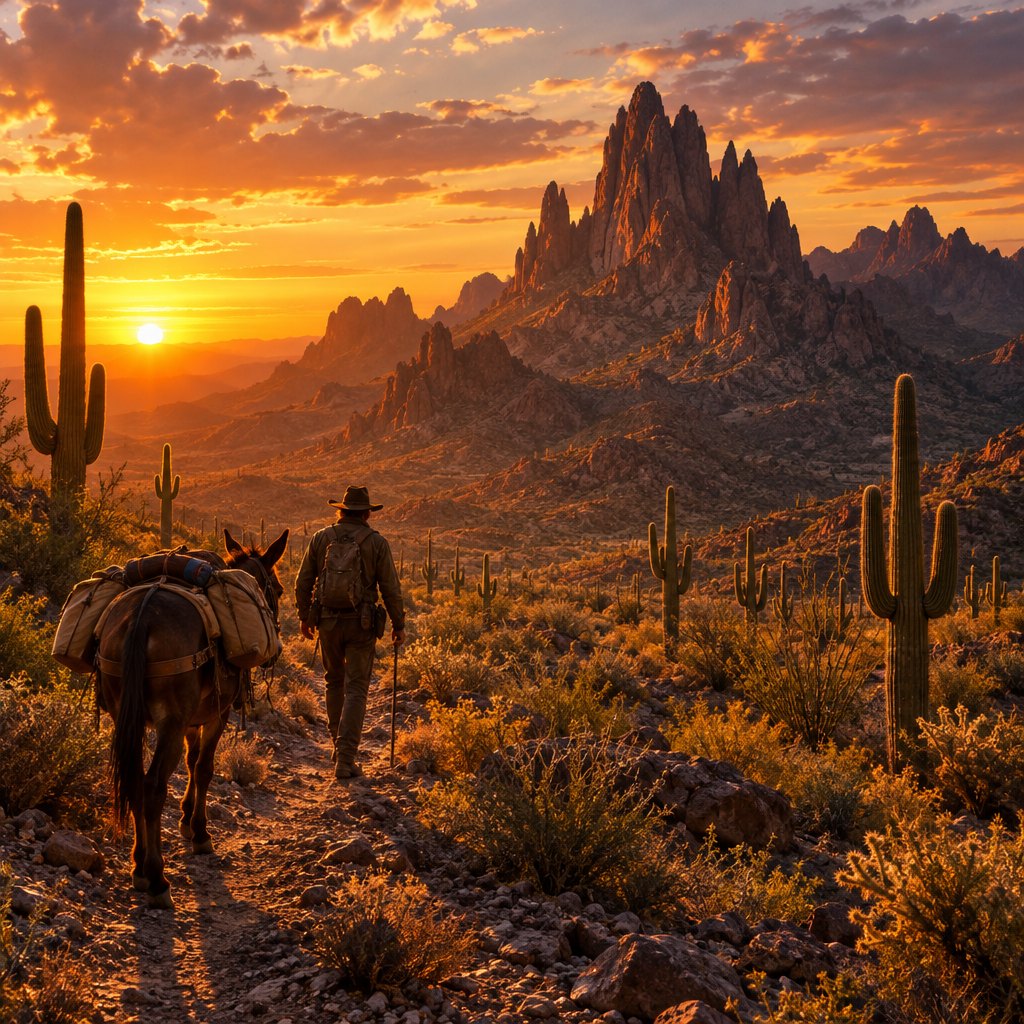
Part of The Superstition Mountains, an Arizona road trip about 145 miles from Show Low. These pages are about the stories first; every fact we could not confirm is labelled.
The Lost Dutchman is Arizona’s most famous lost gold mine: a story, first told after a German prospector named Jacob Waltz died in Phoenix on October 25, 1891, that he had a hidden mine somewhere in the Superstition Mountains. Nobody has ever confirmed one. Arizona State Parks tells the legend, and most of its details have no documents behind them.
Checked · Edited by the It's Show Low Editorial Team · Sources · How we check
Unconfirmed Almost every detail below is folklore. Where tellers disagree we print the range. We found no 1891 or 1931 newspaper original, so the details come from Arizona State Parks, Arizona Highways, the Yuma Sun and a skeptics’ podcast, and we say which.


The Story as It Is Told
According to Arizona State Parks, the Peralta family of northern Mexico mined rich gold in the Superstitions in the 1840s. In 1848 their last expedition, loaded with gold for Mexico, was ambushed by Apaches at a spot the park calls the Massacre Grounds, and one or two survivors escaped. Decades later, in the 1870s, a German immigrant named Jacob Waltz is said to have found the mine with help from a Peralta descendant and worked it with a partner, Jacob Weiser. “Dutchman” was a period word for a German. Waltz hid caches of gold, most often said to be near Weaver’s Needle, and Weiser was killed, by Apaches in some versions and by Waltz in others.
When Waltz died in Phoenix in October 1891, a woman named Julia Thomas, who looked after him, said he described the mine on his deathbed. Sources disagree on who she was: a neighbor (Arizona State Parks), the owner of his boarding house (a skeptics’ podcast) or a baker (hobby sites). In the legend a box of high-grade ore was found under his bed. Searchers, including Thomas, looked for the mine and did not find it.

What Researchers Say
- The Peraltas.The historian Robert Blair, quoted on Wikipedia, argued that a Peralta mine in the Superstitions is a 20th-century invention, and the skeptics’ podcast found no evidence the family mined there. State Parks still tells the Peralta story as legend.
- The partner.Blair also doubted that Weiser existed. The podcast spells the second man “Weisner” and notes that some versions leave him out.
- The money.The podcast says Waltz filed mining claims in California but none in the Superstitions, and that no records show real mining income. A claim that a “Jacob Walzer” sold about $250,000 of gold to the U.S. Mint comes from one source and is not confirmed.
- The rock.The range is volcanic. The skeptics’ podcast and the author John Wilburn (as quoted on Wikipedia) say it holds no significant gold. A treasure-hunting site argues the opposite. We could not read the Arizona Geological Survey’s own report on the area, so we cannot say what the survey concludes about gold.
The real gold in this country was at the foot of the mountains: Goldfield, found in 1892, was a low-grade gold camp. That is one reason the story does not sound absurd.
Where The Accounts Disagree
| Detail | What sources say |
|---|---|
| Year Waltz died | 1891 in nearly every source; one Forest Service history chapter says 1881, which looks like a typo |
| Waltz’s age | About 81 (born about 1810, per one history site) |
| Julia Thomas | Neighbor, boarding-house owner or baker, depending on the teller |
| Gold under the bed | Weight and value (one hobby site says about 48 pounds, about $4,800) are not confirmed; who got it is disputed |
| Spread of the legend | A skeptics’ podcast says a January 13, 1895 San Francisco Chronicle story made it famous; not confirmed elsewhere |
Weaver’s Needle
Weaver’s Needle is a volcanic plug of tuff, about 4,550 ft high (sources print 4,553 to 4,555 ft). Arizona State Parks says the caches were most often placed near it, and a common retelling says its shadow points to the vein. It sits inside the Superstition Wilderness on Tonto National Forest land. You can see it from the free Needle Vista overlook without hiking. The name is said to honor the mountain man Pauline Weaver; that comes from Wikipedia only and is not confirmed.
Searching for It Today
Treasure hunters still go. We could not find a Tonto National Forest or Lost Dutchman State Park page that says metal detectors and digging are banned in the wilderness, and we will not state a rule we could not read. What we did read: the state park says removing or damaging plants, animals or archaeological, geologic or historic objects is a crime, and the Forest Service says artifacts more than 100 years old are protected by federal law (ARPA). Call the park at (480) 982-4485 or the Tonto National Forest before you search or dig anywhere.
The better treasure hunt is a hike. See hiking Lost Dutchman State Park. For the mine’s cousins, read Arizona’s Lost Mine Legends and the White Mountains’ own Lost Adams Diggings.
More on The Superstition Mountains
Local Legend: The Lost Dutchman’s Gold Mine
What is actually true: Arizona State Parks tells the legend and says Waltz died in Phoenix on October 25, 1891; the Peralta family backstory and the gold under his bed are part of the legend. No mine has ever been confirmed. The historian Robert Blair, quoted on Wikipedia, argued that a Peralta mine in the Superstitions is a 20th-century invention and doubted that Waltz’s partner Jacob Weiser existed, and a skeptics’ podcast says Waltz filed no mining claims in the Superstitions. Sources disagree on who the woman was (a neighbor, a boarding-house owner or a baker). The range is about 145 road miles from Show Low. Sources: Arizona State Parks: The Dutchman
Arizona Highways (April 2007): the Lost Dutchman story
Skeptoid #347: The Lost Dutchman’s Gold Mine
Wikipedia: Lost Dutchman’s Gold Mine (a pointer, not a source of record)
The Editors’ TakeTall Tale (We Love It Anyway)
Jacob Waltz died in Phoenix on October 25, 1891, and that may be the one part nobody argues about. Historian Robert Blair called the Peralta mine a twentieth-century invention, a skeptics’ podcast says Waltz filed no claims in the Superstitions, and the sources cannot agree who the woman at his bedside was. A mine nobody has confirmed since 1891 is exactly what keeps the story alive. We love it, and we would not bet a pickaxe on it.
6-1 for Tall Tale (We Love It Anyway), with one editor preferring Good Story, Thin Proof since nobody can prove the mine is not there.
If you go: The range is about 145 road miles from Show Low.
Questions People Ask
Is the Lost Dutchman Mine real?
No mine has ever been confirmed. The story of Jacob Waltz is documented only in part, and the Peralta and gold-under-the-bed details are legend.
Who was the Lost Dutchman?
Jacob Waltz, a German-born prospector who died in Phoenix on October 25, 1891. “Dutchman” was a period word for a German.
Can I look for the Lost Dutchman Mine?
You can hike the area, but digging, taking artifacts or damaging anything is against state and federal rules. Ask the Tonto National Forest or the park first.
Sources
- Arizona State Parks: The Dutchman
- Arizona State Parks: Lost Dutchman State Park history
- Arizona Highways (April 2007): the Lost Dutchman story
- Yuma Sun: What or who killed mine hunter (Adolph Ruth)
- Skeptoid #347: The Lost Dutchman’s Gold Mine
- The Clio: Jacob Waltz and the Lost Dutchman Mine
- Wikipedia: Lost Dutchman’s Gold Mine (a pointer, not a source of record)
- Legends of America: The Lost Dutchman Mine
- Wilderness.net: Superstition Wilderness
- Forest Service: Archaeological resources protection (ARPA)
- Arizona State Parks: Lost Dutchman facility information
Checked October 31, 2026 by It’s Show Low. Cite this page: It’s Show Low (itsshowlow.com), checked October 31, 2026. Free to quote with a link.